
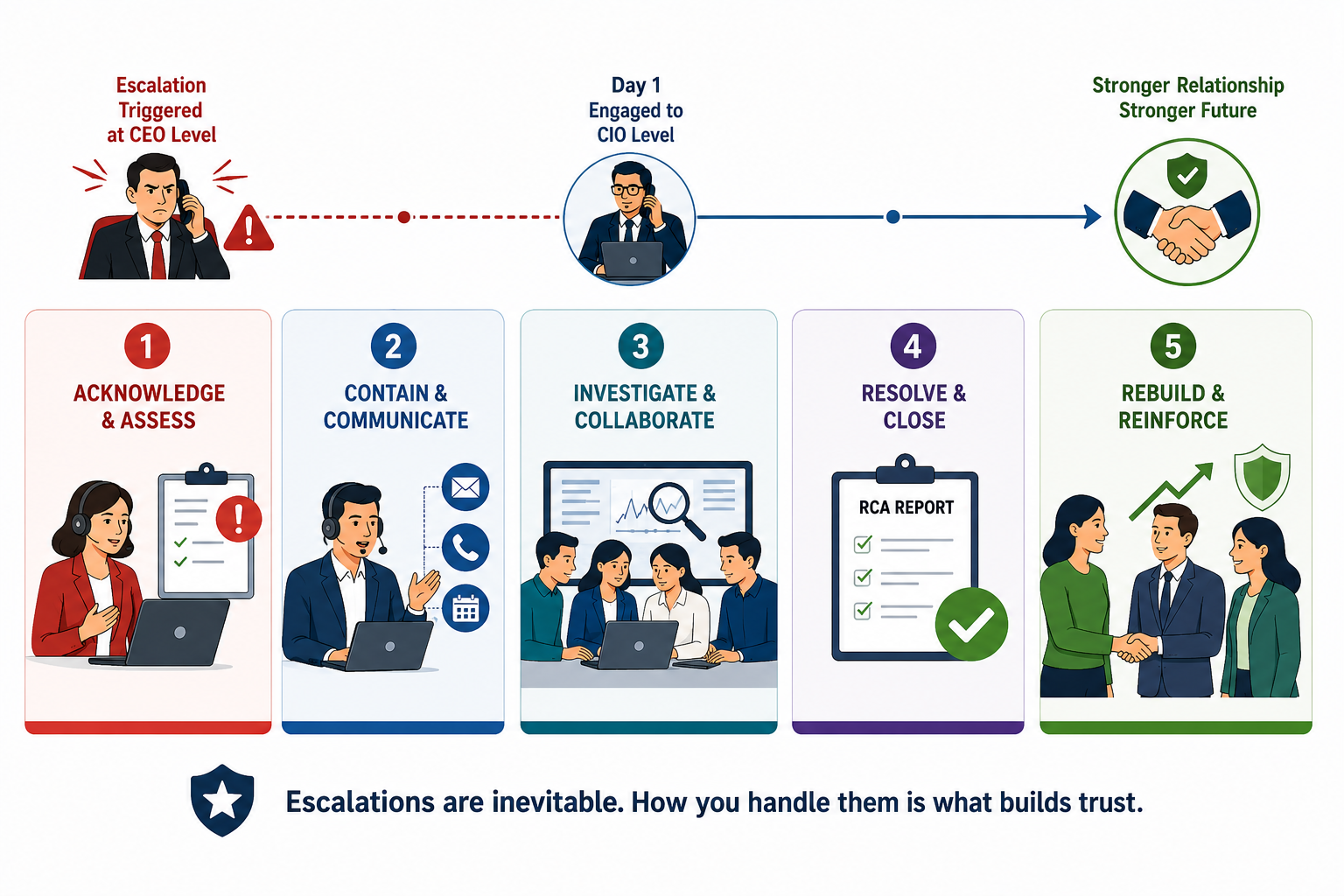
Phase 1 — Acknowledge & Assess (Day 0–1)
The first 24 hours set the tone for the entire escalation. Speed and visible ownership matter more than having all the answers right away.
• Acknowledge immediately — contact the customer before they contact you again
• Identify the escalation tier — is this a CXO-level issue? Does it impact the customer's business continuity or reputation?
• Assign an escalation owner — a named, senior individual, not a team or a ticket
• Brief internal leadership — your CIO/VP needs to know before the customer's CIO calls them
In the story, the escalation was triggered at CEO level. The response correctly elevated to CIO engagement on Day 1.
Phase 2 — Contain & Communicate
Before the root cause is known, credibility is built through communication, not solutions.
• Set up a structured cadence — daily updates via email and phone during the acute phase
• Lead with empathy — let the customer vent; do not interrupt or defend; listen fully
• Make a commitment, not a claim — say "we own this" before you know the answer
• Avoid premature diagnosis — if you suspect another party (network, vendor), do not say so without proof; it reads as deflection
• Document every interaction — timestamps, action items, owner names
Phase 3 — Investigate & Collaborate
Escalations involving intermittent or non-reproducible issues require creative problem-solving, not just standard playbooks.
• Form a dedicated war room team — cross-functional, with engineering and field resources
• Build for capture, not just fix — when an issue can't be reproduced, engineer a way to capture it (custom firmware, enhanced logging, synthetic monitoring)
• Involve the customer as a partner — share your investigation approach; it builds trust and reduces anxiety
• Provide proof points, not assurances — data and logs beat promises every time
Phase 4 — Resolve & Close (Post-Root Cause)
Resolution without proper closure is an incomplete escalation. Closure is a relationship act, not just a technical one.
• Share findings transparently — even if the root cause points elsewhere (e.g., customer's network), present with evidence and without blame
• Propose joint corrective actions — frame it as "here's what we're doing together"
• Deliver a formal RCA document — even for intermittent issues; it signals maturity
• Implement systemic improvements — update firmware, processes, or run-books so the same scenario is handled faster next time.
Phase 5 — Rebuild & Reinforce (Post-Resolution)
The escalation is an opportunity — not just a crisis. Handled well, it deepens the customer relationship.
• Schedule a post-mortem with the customer — not to re-litigate, but to jointly identify improvements
• Recognize the internal team — escalations are stressful; visible recognition builds team morale
• Update your escalation runbook — capture what worked, what didn't, and what new tools were built
• Track the relationship trajectory — monitor sentiment in the next 90 days; a detractor can become a champion