
Inside Kodiflex Support: What Actually Happens to a Ticket Before It Reaches a Customer
Most AI support tools work the same way: a question comes in, a model generates an answer, the answer goes out. One step. One model. One shot at being right.
That's not how Kodiflex Support works — and the difference is the whole point.
A controlled decision pipeline, not a chatbot
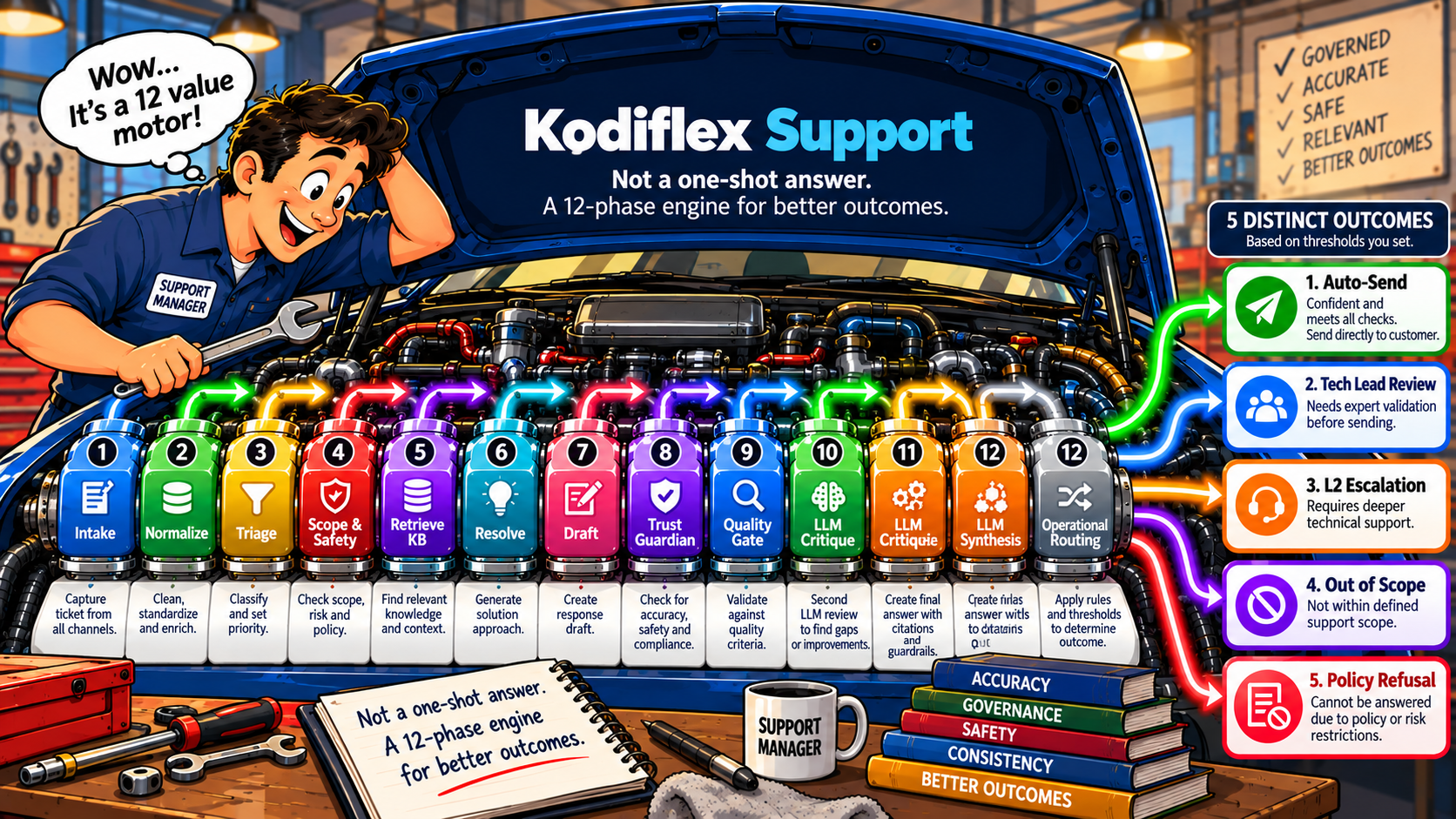
Kodiflex wraps its models inside a 12-phase governed pipeline, split into four stages: case understanding, problem solving, AI assurance, and operational routing. The core principle running through all of it is simple to state and hard to fake: generate, validate, critique, synthesize, gate, route. A human can step in at any point. Nothing skips a step just because it's confident.
Stage A — Case Understanding (Phases 1–4). Before anything gets solved, the ticket gets understood. Intake captures it. Normalize cleans it up. Triage classifies intent and urgency. Scope & Safety checks whether the case is even safe and in-scope to attempt. A support ticket about a billing dispute and one about a security vulnerability don't get treated the same way from the first second — and if something shouldn't be touched by automation at all, this is where that gets caught, before any resolution attempt begins.
Stage B — Problem Solving (Phases 5–7). Only once the case is understood does the system try to solve it. Retrieve KB grounds the response in your actual documented fixes and knowledge base — not the model's general training data. Resolve builds the technical solution. Draft writes the customer-facing response. The ordering matters: there's no generating an answer before it's grounded in something real. A lot of "AI hallucination" in support contexts is really just this step being skipped.
Stage C — AI Assurance (Phases 8–11). This is the stage most generic AI tools don't have at all, and it's the one that actually makes the difference. Trust Guardian and Quality Gate check the draft against defined thresholds. Then — critically — an independent second model performs LLM Critique, stress-testing the first model's work, before LLM Synthesis produces the final version. The model that generated the answer doesn't get to grade its own homework. That separation, not any amount of self-checking within one model, is what makes the quality assurance here structurally reliable rather than just a confidence score.
Stage D — Operational Routing (Phase 12). Here's where most AI support tools stop short: they give you resolved or escalated, full stop. Kodiflex routes every ticket to one of five distinct outcomes, based on thresholds your organization sets — not thresholds Kodiflex decides for you:
① Auto-Send — Kodiflex is confident, and the answer goes straight to the customer. No human in the loop. The highest-efficiency outcome, fully governed and fully auditable.
② Tech Lead Review — reasonably confident, but the case warrants a second set of expert eyes before it goes out. This is the outcome most AI tools don't have at all: a safe place for uncertainty to go that isn't a full escalation and isn't a guess.
③ L2 Escalation — Kodiflex either lacks the domain expertise or judges the issue too critical for automation to be the resolution path. It hands off cleanly, with full case context attached, rather than forcing a guess.
④ Out of Scope — the request falls outside the support domain entirely. It's handled without consuming technical resources or quietly polluting your resolution metrics.
⑤ Policy Refusal — the request is in-scope but violates policy. Kodiflex refuses to respond rather than risk a compliance breach. Explicit, logged, non-negotiable.
Binary routing forces every AI system into a false choice: claim confidence it doesn't have, or escalate things it could actually handle. A dedicated review path in the middle is the difference between a tool that answers and a system you can govern — and because the thresholds for all five outcomes are tenant-specific, what triggers Auto-Send for one organization might route to Tech Lead Review for another. Your risk tolerance, not ours, decides where the line sits.
Twelve phases. Four stages. Five outcomes. Every decision logged and auditable, every threshold yours to configure. That's what "governed automation" actually means in practice — not a slogan, a specific architecture.