
A few years ago, we were operating in an intensely competitive market.
From a product perspective, there was very little separating us from our closest competitor. Features were similar. Functionality was comparable. Both products solved the same customer problems.
Competing on technology alone wasn't enough.
Together with our country sales leadership, we asked ourselves a simple question:
What can we offer that our competitors can't easily replicate?
The answer wasn't another feature.
It was outcomes.
Instead of selling video collaboration products, we decided to sell a premium managed service where customers outsourced the day-to-day management of their video environment to us while they focused on their core business.
It was a compelling proposition.
There was just one problem. We had to rebuild the business before we could sell it.
The company had offered a similar premium service several years earlier.
It had been successful with some of the world's largest enterprises, but it was expensive. Over time, customers moved away, the business shrank, and the specialist teams supporting the service were dissolved.
Now we wanted to enter the market again.
But we didn't have all the ingredients.
The people had moved on.
The processes no longer existed.
Some of the specialist skills had disappeared.
Just then, an opportunity arrived.
One of our strategic customers had a video collaboration solution deployed by a system integrator.
The platform worked.
But it had become difficult to use, inconsistent across locations, and expensive to maintain.
The customer's ask was surprisingly simple:
Simplify the user experience. Standardize every deployment. Make the entire environment easier to support.
It was exactly the kind of engagement we wanted.
Except for one detail.
We had almost no visibility into how the existing solution had been built. We were preparing a competitive bid without knowing what was behind the curtain.
We were, quite literally, flying blind.
Our hypothesis was simple.
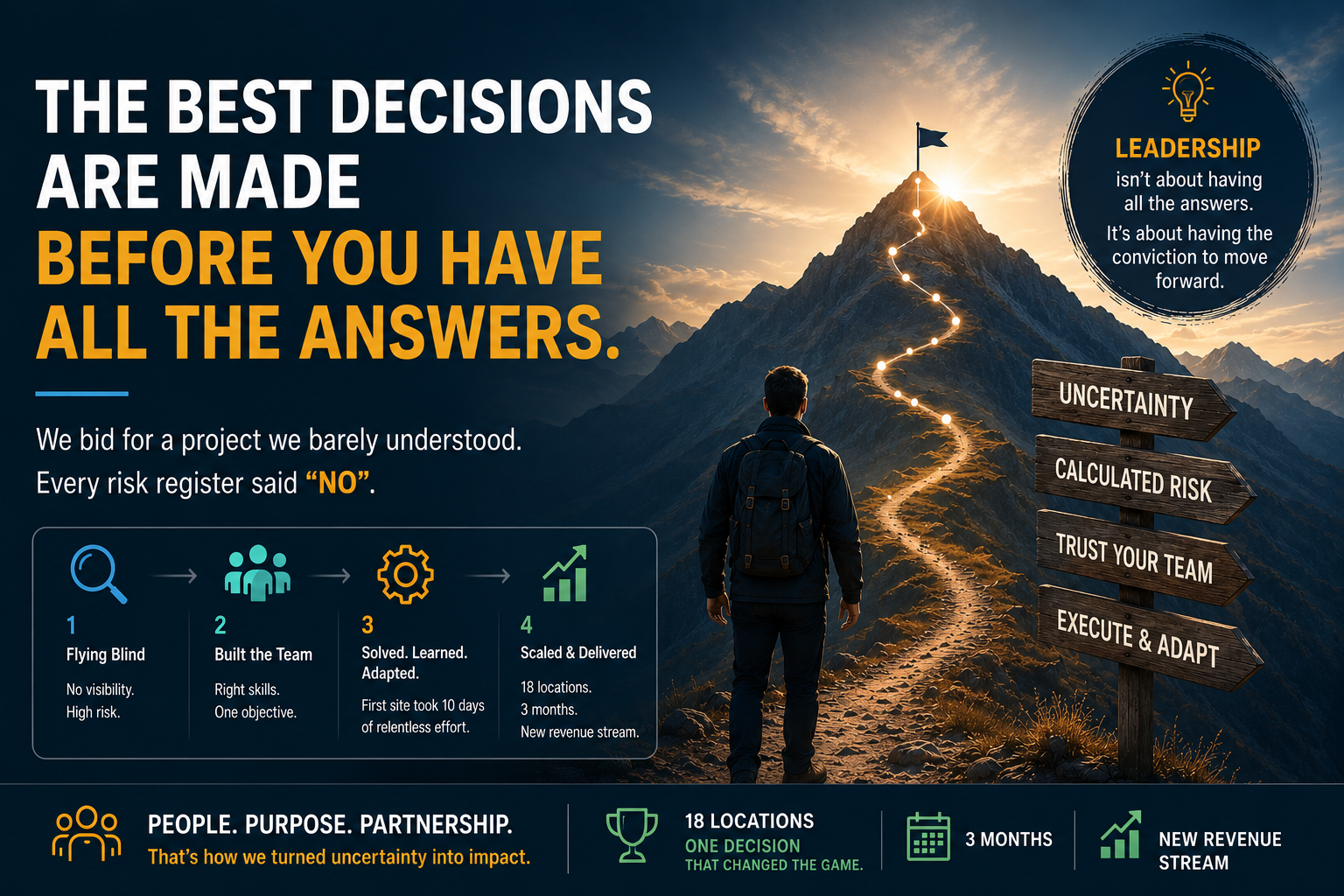
The customer had 18 locations.
If we could solve the first two or three, we could create a repeatable template for the remaining sites.
Corporate headquarters looked at the proposal and rejected it.
The risks were simply too high.
And they weren't wrong.
But the local leadership believed the opportunity justified taking that calculated risk.
So we submitted the proposal.
And we won. Then reality arrived.
We assembled a cross-functional team by bringing together specialists from different parts of the organization.
No single team possessed every skill we needed. Collectively, they did.
The first site took ten exhausting days. Every day followed the same routine. Test. Fail. Learn. Try again.
The system had been installed more than eight years earlier, and every new discovery created another challenge we hadn't anticipated.
We also realized there were areas where our own expertise wasn't enough. Instead of seeing that as a weakness, we reached out to partners across our ecosystem, combining their experience with ours to develop practical, scalable solutions.
After ten days, we finally cracked the first site.
The second and third sites still presented surprises, but something had changed. Our learning curve had become steeper than the complexity curve.
By the third implementation, we had built our template.
Over the next three months, we successfully standardized all 18 locations. What had started as a risky decision became an entirely new revenue stream for the business. Looking back, the project reinforced four leadership lessons.
1. Leadership rarely comes with perfect information.
If you wait until every risk is eliminated, someone else will capture the opportunity. Good leaders make informed decisions—not perfect ones.
2. Great teams are built by combining strengths, not collecting experts.
No individual had all the answers.
Together, the team had enough to solve every problem that came our way.
3. Executive sponsorship creates space for innovation.
Bold ideas need leaders who are willing to back them when success isn't guaranteed. Without that support, most organizations default to playing safe.
4. Frontline leadership builds confidence.
Working alongside the team during the toughest days wasn't about oversight. It was about sending a simple message:
We're in this together.
That belief kept the team moving when the easier option would have been to walk away.