
The Hidden Cost of Support Layers: Lessons from Redesigning a Global Support Organisation
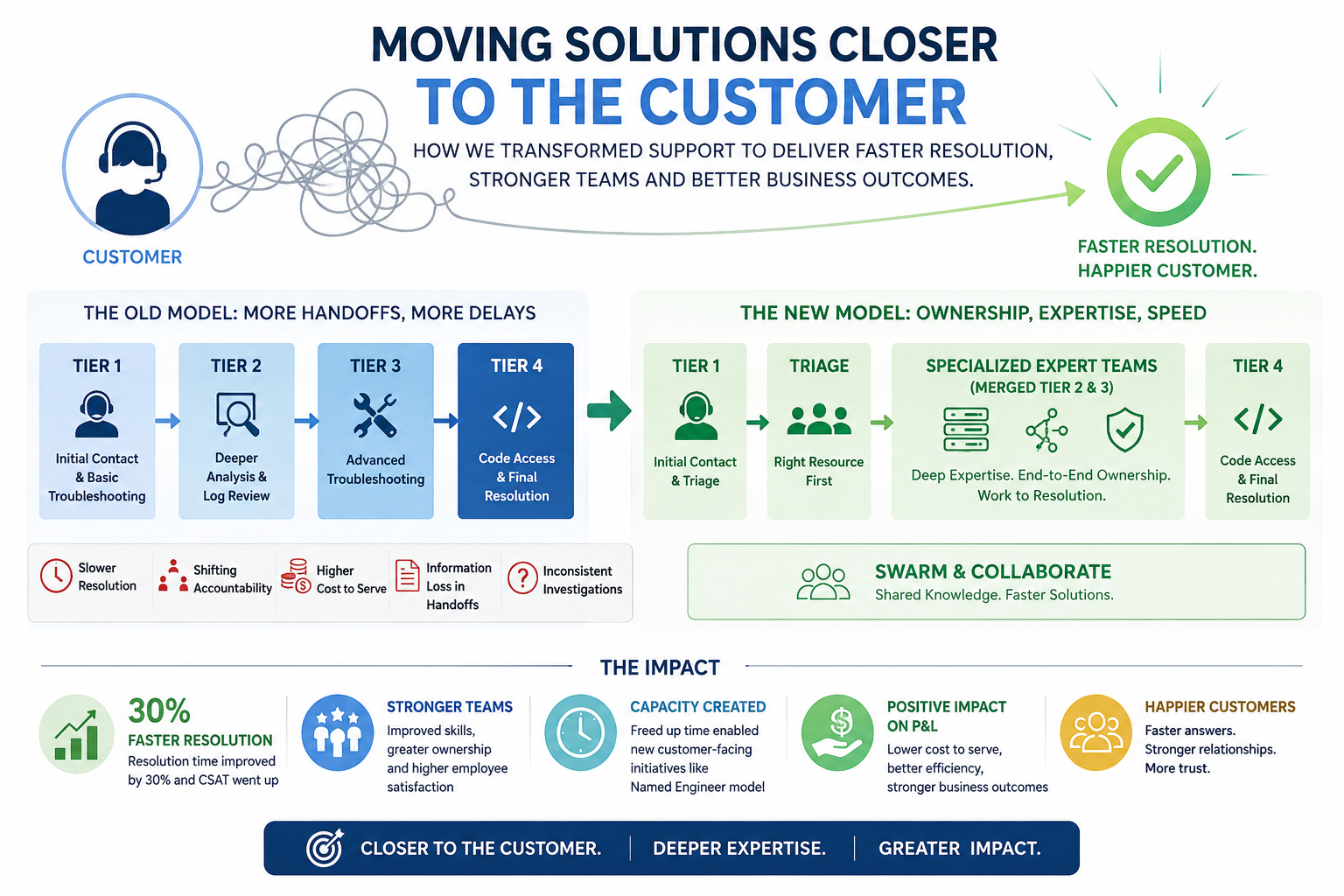
Why I Moved Customer Support Closer to the Customer — And Why It Changed Everything
In many technology organizations, customer support evolves organically over time. New products are launched, more customers come in, teams grow, and layers of specialization get added. While every change may solve an immediate problem, over the years something unexpected can happen: the process itself becomes the problem.
I encountered this firsthand while leading a large customer support organization in the enterprise communication technology space.
The product itself had strong customer affinity. Customers had used it for years and relied heavily on it to run critical business operations. But when something went wrong, the path from customer issue to customer resolution had become unnecessarily complicated.
What started as a support structure designed to help customers had slowly become a system that was creating friction.
The Original Support Model
The support structure followed a traditional tiered approach:
Tier 1
* First customer contact * Entitlement checks * Initial troubleshooting * Knowledge base search and resolution
Tier 2
* Deeper troubleshooting * Log analysis * Intermediate technical resolution
Tier 3
* Advanced troubleshooting * Experienced specialists with additional tools and expertise
Tier 4
* Final escalation point * Access to source code * Capability to determine whether the issue was:
* A software bug * Working as designed * A feature request * Not reproducible
On paper, the model looked structured and logical.
In reality, customers experienced something very different.
The Hidden Cost of Layers
As I studied support trends and customer experiences, several patterns became clear.
### 1. More tiers meant slower outcomes
Every escalation introduced delays. Tickets waited in queues, changed ownership, and lost momentum.
### 2. Accountability became fragmented
As tickets moved from Tier 1 to Tier 4, ownership moved with them.
No individual truly felt responsible for the entire customer journey.
### 3. Cost increased with every escalation
The farther a ticket moved away from the customer-facing edge, the more expensive it became to solve.
### 4. Information degraded during handoffs
Customers frequently had to repeat information multiple times.
Nothing frustrates customers more than explaining the same problem repeatedly.
### 5. Different people often investigated the same issue differently
Because skill distribution across teams wasn't consistent, investigations could change direction after weeks of effort.
Customers weren't just waiting for answers.
Sometimes the organization itself was trying to decide how to think about the problem.
Rethinking the Problem
Instead of asking:
*"How do we improve the existing process?"*
We asked a different question:
*"How do we structurally move problem-solving closer to the customer?"*
That question changed everything.
What We Changed
### 1. Reduced layers by merging Tier 2 and Tier 3
Fewer layers meant fewer handoffs and faster movement toward resolution.
### 2. Shifted from generalists to specialized virtual towers
Previously, everyone worked on everything.
While that seemed flexible, it created inefficiencies.
We reorganized teams into virtual towers aligned to products and skillsets.
Specialization helped teams build deeper expertise and stronger problem-solving capability.
### 3. Introduced a triage function
We created a "Right Resource First" model.
Instead of tickets moving through multiple people before reaching the right expert, we aimed to send issues to the best-qualified person from the beginning.
### 4. Increased ownership
The person who received the ticket after Tier 1 now worked it through to resolution.
This created:
* Greater accountability * Better continuity * Stronger learning opportunities * Broader skill development
### 5. Encouraged swarming
One of the most powerful changes came from creating specialized communities that collaborated around open issues.
Rather than working in isolation, teams came together to swarm difficult problems.
Ideas surfaced faster.
Patterns emerged faster.
Solutions happened faster.
### 6. Managed change carefully
Interestingly, while roles and responsibilities evolved, organizational structures initially remained unchanged.
This created buy-in from managers, technical leads, and senior engineers without introducing unnecessary disruption.
Transformation succeeds when people adopt the change—not simply when org charts change.
The Results
The outcomes were significant.
30% improvement in resolution time
Customers received answers faster and customer satisfaction improved.
Higher employee engagement
Team members developed deeper expertise and gained more ownership of outcomes.
Capacity creation
Operational efficiency freed up time that could be invested elsewhere.
We used that capacity to introduce new customer-facing capabilities such as a Named Engineer model for strategic customers.
Positive impact on financial performance
Resolution moved closer to the customer, reducing cost to serve and improving overall economics.
Lessons I Took Away
### Keep customer-facing teams structurally close to customers
The closer decision-making and problem-solving are to the customer experience, the faster organizations respond and adapt.
### Specialization creates organizational muscle
Deep expertise compounds over time and becomes a competitive advantage.
### Efficiency should create growth, not just savings
Too often organizations stop after reducing costs.
The real opportunity is to redirect efficiency gains into initiatives that create additional customer value and business growth.
Final Thought
Many organizations assume customer support is primarily a cost center.
I have learned the opposite.
When designed correctly, support becomes a strategic advantage.
The teams closest to customers hear the earliest signals, understand problems at the deepest level, and often identify opportunities before anyone else.
Sometimes transformation is not about adding more process.
It is about removing the distance between customers and the people who can help them.