
The Technical Support Problem Nobody's Naming — And Why “Just Add AI” Doesn't Fix It
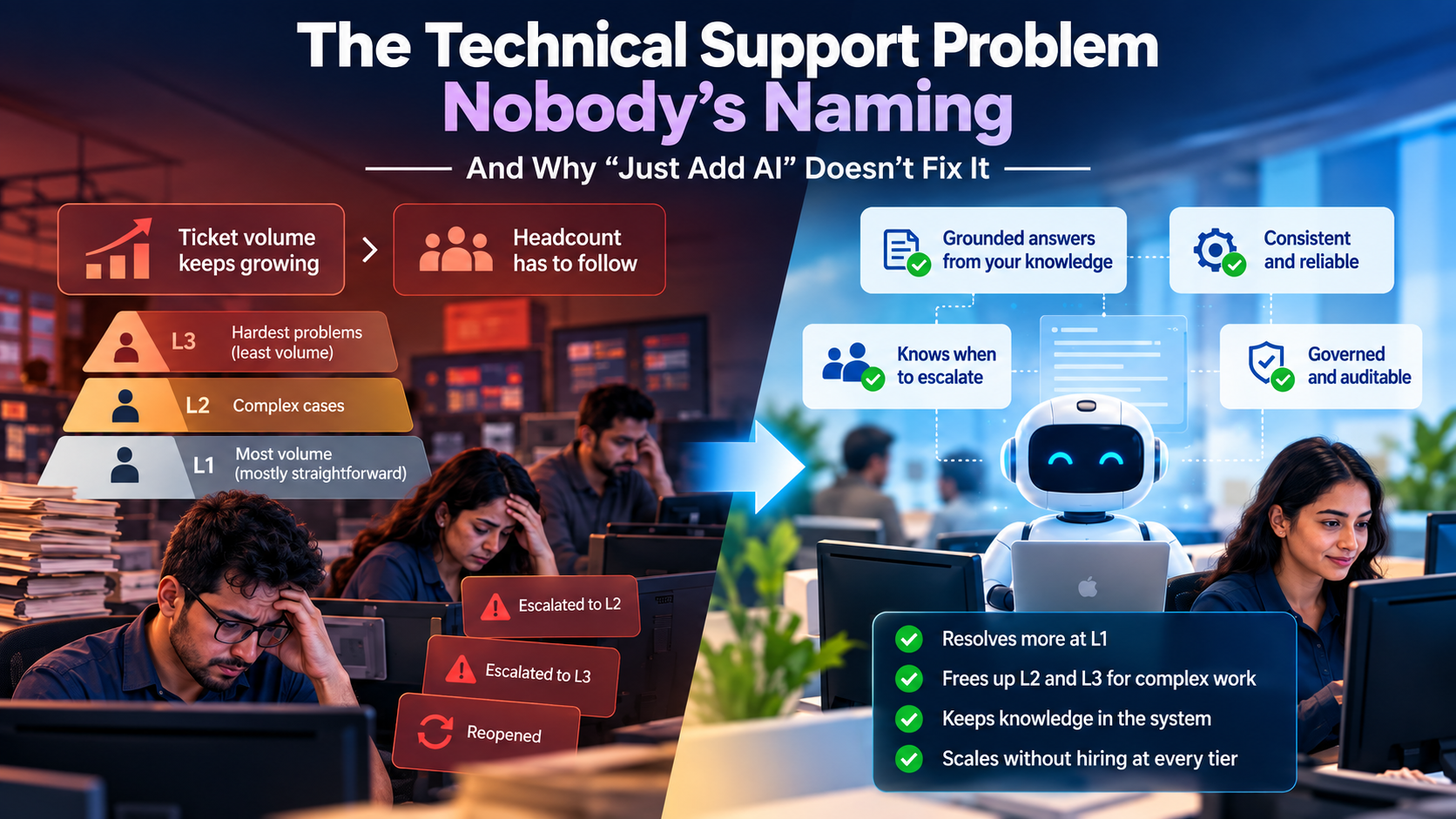
Every technical support organization eventually hits the same wall.
Ticket volume goes up 10%, and headcount has to follow almost one-for-one.
That isn't necessarily because your support team is inefficient. It is a consequence of how many technical support organizations are structured.
Many teams operate across three broad tiers.
L1 handles the bulk of the volume — mostly straightforward issues.
L2 handles more technically complex cases.
L3 — your most senior and expensive people — handles the smallest volume, but usually the hardest problems.
Here's the catch.
L1 talent can often be hired and trained relatively quickly.
L2 and L3 are different.
They take months to become productive. They are expensive to replace. And when someone leaves, they take years of accumulated judgment and experience with them.
So when ticket volume grows, you're not simply adding people.
You're trying to scale the scarcest, slowest-to-build and hardest-to-retain part of your organization at the same rate as the easiest part.
That's the real scaling problem.
And that's exactly the kind of problem governed automation can help solve.
Done right, automation doesn't just reduce cost per ticket.
It gives L2 and L3 experts their time back for the work that actually needs them.
It keeps valuable knowledge available in the system instead of walking out the door with the next departure.
And it allows the organization to handle more volume without simply hiring its way through every tier.
Cost is one benefit. Getting your best people back is the bigger one.
But scaling headcount is only one part of what is broken in technical support today.
And that's where the bigger opportunity — and the bigger AI challenge — begins.
The problem is bigger than headcount
1. Product complexity increases the cost of a wrong answer
In a simple support environment, a wrong answer may mean another interaction.
In a complex technical product, it can be much more expensive.
A misdiagnosed configuration issue can lead to a failed fix, additional troubleshooting, escalation, customer frustration and, in some environments, even a data-integrity or compliance concern.
The more technical the product, the more expensive a wrong answer becomes.
#2. Escalations often happen because knowledge isn't accessible
Consider a documented configuration problem that has already been solved.
L1 receives the ticket but doesn't recognize it.
It goes to L2.
L2 investigates, doesn't recognize it either, and escalates again.
L3 finally identifies it — because they were the person who solved and documented the issue six months ago.
The customer eventually gets the right answer.
But three levels of technical capacity were consumed to rediscover something the organization already knew.
The problem wasn't the absence of knowledge.
The problem was getting the right knowledge to the right person at the right time.**
3. Attrition takes knowledge with it
Support organizations can experience significant employee turnover, particularly in high-demand technical environments.
But the cost of losing an experienced L2 or L3 isn't just the cost of recruiting a replacement.
It's the judgment that person accumulated over months and years.
Which symptoms matter?
Which logs should you look at first?
Which configuration changes have caused problems before?
When should you stop troubleshooting and escalate?
A knowledge base can capture documented procedures.
It is much harder to capture the judgment behind the procedure.
And when that knowledge leaves, the replacement starts from somewhere behind the person who left.
4. Cost-to-serve becomes a scaling problem
As ticket volumes increase, support eventually becomes a P&L conversation.
The challenge isn't simply how much you pay an individual support engineer.
It is how many levels of expertise are consumed to resolve each customer issue.
A ticket that could have been resolved at L1 but travels through L2 and L3 has consumed considerably more organizational capacity than necessary.
So the question isn't just:
“How much does a support engineer cost?”
It is:
“How much expertise does it take to resolve each customer problem?”
And that brings us to AI.
Why “just add a chatbot” doesn't fix it
Once organizations see these problems, the obvious response is often:
“Let's add AI.”
A chatbot is deployed.
The knowledge base is connected.
The AI starts answering customer questions.
And yet, the underlying problem often remains.
Why?
Because answering a question is not the same as managing a support workflow.
There are four fundamental challenges.
1. Hallucination
A generic LLM can produce a fluent and convincing answer even when the underlying information isn't reliable.
In technical support, that is a serious problem.
A confidently wrong root-cause diagnosis can send an engineer down the wrong path, waste the customer's time and damage trust.
The goal isn't simply to generate an answer.
The goal is to generate an answer that can be trusted.
2. Inconsistency
Ask the same technical question multiple times and a generic AI system may produce variations in its response.
That may be acceptable for brainstorming.
It is much less acceptable in enterprise technical support.
Support organizations need consistency.
If the same question has the same approved answer, the system should be able to reproduce that answer reliably.
3. Guardrails
Not every question should be answered automatically.
Some issues require escalation.
Some information should never be exposed to a customer.
Some actions require human approval.
Some customers may have contractual, regulatory or security requirements that change how a case should be handled.
A support AI therefore needs more than the ability to answer.
It needs to know when not to answer.
4. Governance
This is perhaps the biggest difference between an AI experiment and an enterprise support system.
Who approved the knowledge being used?
Why did the system provide this answer?
What happens when the knowledge base changes?
Which cases can be resolved automatically?
Which cases require human intervention?
Can the response be audited later?
Can different customers have different policies?
These aren't chatbot questions.
They're governance questions.
And that's why simply adding an AI chatbot rarely solves the underlying technical support problem.
A chatbot can answer questions.
But technical support is not just about answering questions.
It's about knowledge, workflow, escalation, expertise, risk and accountability working together.
That is the difference between AI that answers and AI that is actually governed.
And that is where I believe the next generation of technical support automation will be built.
Not around replacing support engineers.
But around making the expertise of your best people available wherever and whenever it is needed — without introducing another source of risk.
The goal isn't to add AI to support.
The goal is to make support better with AI.